


Differences Between Medicare Part A and B

Reviewed by Russell Noga, a Licensed Medicare Insurance Broker in all 50 states — Updated October 8, 2026

Medicare Part A covers inpatient hospital care, skilled nursing facility care, hospice and some home health care; Part B covers doctor visits, outpatient care, preventive services, durable medical equipment and some drugs given by providers. Most people pay no Part A premium, while Part B has a monthly premium, $202.90 in 2026.

Together, Parts A and B make up Original Medicare. Neither has a yearly out-of-pocket limit, which is why many people add Medigap or choose Medicare Advantage.

See Medicare plans explained.

✔ Licensed agents in all 50 states
✔ Built on CMS 2027 data
✔ Compare plans for free
Key Highlights

✔

Part A: hospital; Part B: medical.

✔

Most people pay no Part A premium.

✔

Part B premium: $202.90 in 2026; $209.40 for 2027.

✔

Part A deductible: $1,736 per benefit period in 2026.

Compare plans and enroll online

Part A vs Part B at a Glance

Part A Part B
Covers Inpatient hospital, skilled nursing, hospice, some home health Doctors, outpatient, preventive, equipment, some drugs
Premium Usually $0 with 40 quarters of work $202.90/month in 2026 (standard)
Deductible $1,736 per benefit period (2026) $283 per year (2026)
Cost sharing Daily coinsurance after day 60 Usually 20% coinsurance
Yearly cap None None

Part A Costs in 2026

Part A Cost 2026
Deductible per benefit period $1,736
Hospital days 1 to 60 $0 after the deductible
Hospital days 61 to 90 $434 per day
Lifetime reserve days $868 per day
Skilled nursing days 21 to 100 $217 per day

2027 amounts are announced in the fall.

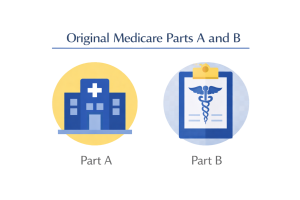
Original Medicare Parts A and B

Find & Compare Plans Online

Speak with a licensed insurance agent

1-877-436-2343TTY 711

Mon-Fri: 8am-9pm ET

Part B Costs

Part B Cost 2026 2027
Standard premium $202.90 $209.40
Deductible $283 $292
Coinsurance Usually 20% Usually 20%

2027 amounts are from CMS, announced November 17, 2026.

Higher-income beneficiaries pay more for Part B through income-related adjustments.

Enrolling in A and B

Most people are enrolled automatically if they already get Social Security at 65; otherwise they sign up during the Initial Enrollment Period, the seven months around their 65th birthday. Delaying Part B without other qualifying coverage can mean a lifelong late enrollment penalty.

Filling the Gaps

Original Medicare Gap What It Means for You Covered By
Part A deductible Charged per hospital benefit period rather than once a year. In 2026 it was $1,736. Fully covered by Plans B, C, D, F, G and N; partly by K, L and M
Part A hospital coinsurance Per-day charges starting after day 60 in the hospital, increasing after day 90 All 10 plans, plus 365 extra hospital days
Part B deductible An annual deductible paid before Part B pays. In 2026 it was $283. Only Plans C and F
Part B coinsurance Typically 20% of the approved amount, without an annual cap All plans (K and L in part, N with copays)
Part B excess charges Doctors who do not accept assignment can charge up to 15% over the approved amount Plans F and G
Skilled nursing coinsurance Charges per day from day 21 through day 100 of a covered stay Plans C, D, F, G, M and N (K and L in part)
Emergency care abroad Care received outside the U.S. is generally not covered by Original Medicare Plans C, D, F, G, M and N, up to plan limits
Medicare Advantage Original Medicare + Medigap
Monthly premium Often low or $0 (2027 average $12, CMS) Higher; varies by plan letter, age and ZIP
Doctors Usually a network Any provider in the U.S. that accepts Medicare
Costs when you get care Copays and coinsurance up to a yearly maximum Predictable and low; on Plan G, little to nothing after the Part B deductible
Drug coverage Usually included Add a separate Part D plan
Dental, vision, hearing Many plans may include some coverage Not included
Changing later Every year during Annual Enrollment In most states, health questions once your Medigap Open Enrollment Period ends

What is Medicare Part A

Turning 65

Turning 65 in 2027? Your Initial Enrollment Period runs for seven months: the three months leading up to your birthday month, the birthday month itself and the three months that follow. Enrolling in the first three months starts your coverage on the first day of your birthday month.

Turning 65 Checklist

✔

Enroll in Part A and Part B, unless you choose to delay Part B because you have qualifying employer coverage

✔

Choose between Original Medicare with Medigap and Medicare Advantage

✔

Avoid a Part D late penalty by enrolling in a drug plan or a Medicare Advantage plan with drug coverage

✔

Going with Medigap? Buy it during your six-month Medigap Open Enrollment Period

All 10 Medigap Plans Compared

Because federal law defines exactly what each plan letter covers, a given letter carries identical benefits from every insurer in your state.

Benefit A B C* D F* G K L M N
Hospital costs and Part A coinsurance for up to 365 additional days Yes Yes Yes Yes Yes Yes Yes Yes Yes Yes
Part B coinsurance or copayment Yes Yes Yes Yes Yes Yes 50% 75% Yes Yes***
First 3 pints of blood Yes Yes Yes Yes Yes Yes 50% 75% Yes Yes
Part A hospice coinsurance or copayment Yes Yes Yes Yes Yes Yes 50% 75% Yes Yes
Skilled nursing facility coinsurance No No Yes Yes Yes Yes 50% 75% Yes Yes
Part A deductible No Yes Yes Yes Yes Yes 50% 75% 50% Yes
Part B deductible No No Yes No Yes No No No No No
Part B excess charges No No No No Yes Yes No No No No
Foreign travel emergency (up to plan limits) No No 80% 80% 80% 80% No No 80% 80%
Out-of-pocket limit None None None None None None Yes** Yes** None None

*Only people who became eligible for Medicare before January 1, 2020 can purchase Plans C and F. **Plans K and L carry an annual out-of-pocket limit set by Medicare each year; once you hit that limit, the plan covers 100% of covered services for the remainder of the year. ***Plan N covers all Part B coinsurance, except you may owe copays of up to $20 for certain office visits and up to $50 for ER visits that do not result in an inpatient admission. Plans in Massachusetts, Minnesota and Wisconsin are standardized in a different way.

Plan G, Plan N and High-Deductible Plan G

Most people new to Medicare choose one of these three. Plan G covers every gap except the Part B deductible. Plan N trades a lower premium for copays of up to $20 for some office visits and up to $50 for ER visits that do not lead to admission, and it does not cover Part B excess charges. High-Deductible Plan G has a $3,050 deductible for 2027, up from $2,950, then covers like Plan G. See Plan G vs Plan N.

Plan G

✔

After the Part B deductible, you pay little or nothing

✔

Covers Part B excess charges

✔

Highest premium of the three

Plan N

✔

You pay the Part B deductible plus small copays

✔

Does not cover Part B excess charges

✔

Usually a lower premium than Plan G

High-Deductible G

✔

In 2027, you pay up to $3,050 before coverage begins

✔

Then covers like Plan G

✔

Lowest premium

How Medigap Prices Are Set

Your Age

Many insurers charge more as you get older.

Your ZIP Code

Prices vary by state and area.

Tobacco Use

Tobacco users usually pay more.

Discounts

Discounts for households or other groups, which vary by insurer and state.

Pricing Method How the Premium Is Set Over Time
Community-rated The premium is the same for everyone in an area, whatever their age Will not go up as you age, but may go up for inflation and other reasons
Issue-age-rated Based on your age when you buy Won’t increase as you age, though other factors can raise it
Attained-age-rated Based on your current age Rises as you age, on top of other increases

Insurer and state determine the method. Before buying, find out how a policy is priced, not only what it costs now.